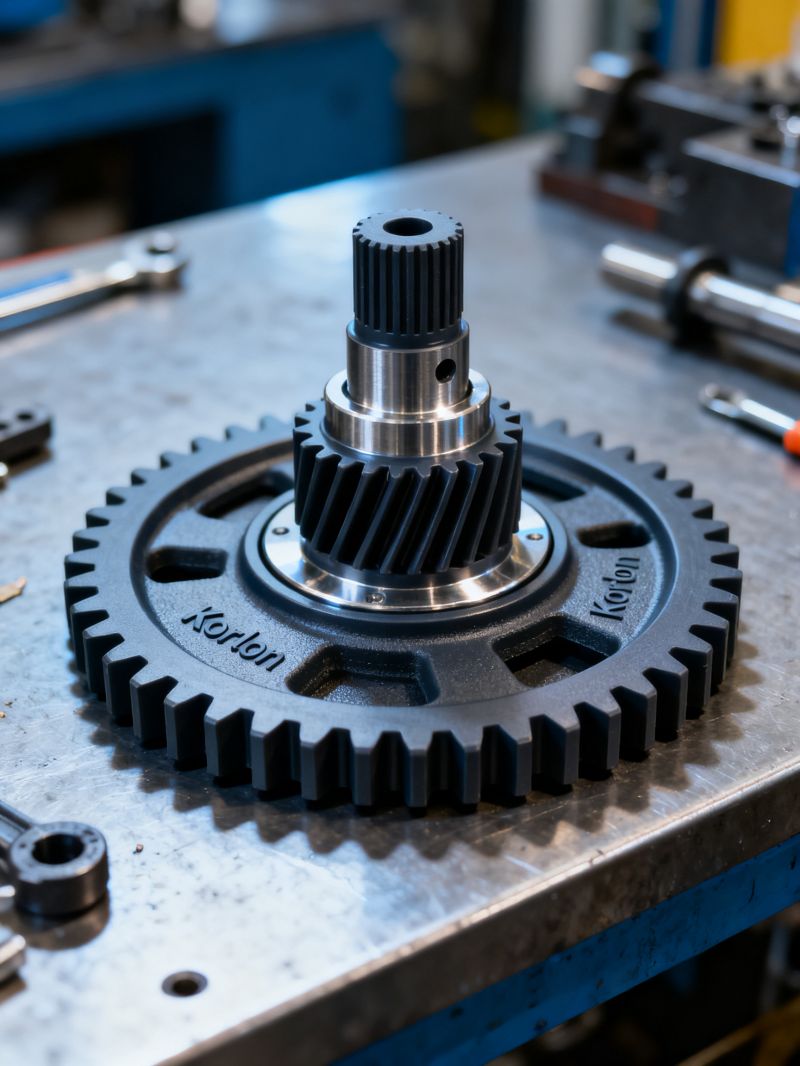
Korlon isn't a household name。but it's likely inside your car, your phone, and the medical device that saved your grandfather's life. This engineering thermoplastic—often mistaken for a simple commodity plastic—delivers a combination of heat resistance, dimensional stability, and chemical inertness that few materials can match. Walk into any precision manufacturing plant, and you'll find Korlon components quietly doing their job where metal would corrode and ordinary plastics would warp.What makes Korlon stand out?Its semi-crystalline structure gives it a melting point north of 300°C, yet it processes like a dream on standard injection molding equipment. I've seen Korlon gears replace brass in industrial pumps, cutting weight by 60% and eliminating lubrication entirely. That's not marketing fluff—it's a direct observation from a field engineer I spoke with last year. The material's low moisture absorption also means parts stay dimensionally true even in humid environments, a problem that plagues nylon and POM in similar applications.Korlon's real advantage emerges in harsh chemical settings. A client in the semiconductor industry switched their wafer-handling fixtures from PVDF to Korlon after repeated stress-cracking failures. The Korlon parts have now run for 18 months without a single crack, exposed to aggressive acids and solvents daily. That kind of real-world durability explains why Korlon has quietly become the go-to polymer for fluid handling systems in chemical plants. It's not flashy, but it works. And in engineering, working reliably for a decade beats any spec sheet.Processing Korlon requires attention to detail. Mold temperatures need to run hot—around 120–140°C—to achieve full crystallinity. Skip that step, and you'll get brittle parts that fail under load. I've seen inexperienced molders blame the material when the real culprit was a cold mold. Drying is equally critical;
although Korlon absorbs less moisture than many nylons, residual water can still cause surface defects and weak weld lines. Get the basics right, and Korlon rewards you with excellent flow and low warpage.Cost-wise, Korlon sits above commodity plastics but below PEEK and PEI. For applications needing continuous service up to 150°C with good chemical resistance, it often hits the sweet spot. The automotive sector has noticed—Korlon is increasingly specified for under-the-hood connectors and sensor housings. My take: Korlon doesn't need hype. It needs engineers who understand its processing window and design for its anisotropic shrinkage. Do that, and you'll wonder why you ever tolerated metal's weight or cheaper plastics' failures.